
Many families in the Gulf divide their year between more than one home, and their childcare has to work across all of them. A single nanny, however experienced, cannot provide care around the clock, across several time zones, for weeks at a time: when one person carries the whole role without proper rest, the arrangement usually fails within the year.
The rota system is the standard answer to this problem. The role is shared between two experienced nannies. One works a set block of days or weeks while the other is off duty, and the two then change over. The children are cared for by two familiar people, and each nanny returns to work rested.
This guide explains what a rota nanny is, how the rotation works in practice, how a rota differs from a live-in nanny, what to look for when you hire, and how families in Dubai and the GCC set the arrangement up.
| Direct Answer: A rota nanny is one of two professional nannies who share a single childcare role in rotation. Each nanny works a set block of days or weeks while the other is off duty, and the two then change over, with a full handover between them. The arrangement gives children continuous care from two familiar carers, and it suits families who travel frequently, keep more than one home, or need cover across long days and nights. |
What Is a Rota Nanny?
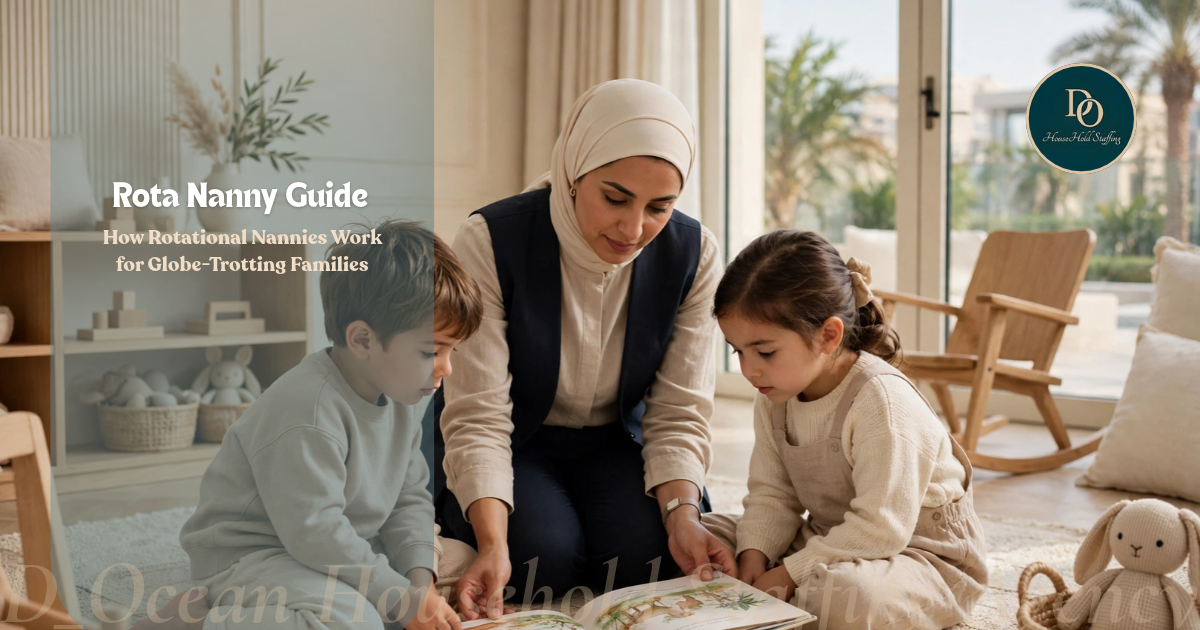
A rota nanny, also called a rotational nanny, is a professional nanny employed as one half of a pair. Together, the two nannies cover one complete childcare role throughout the year. Separately, each nanny works her block and then takes her block off. The role never stops, but the people in it rest properly.
A rota is not a part-time post, and it is not two nannies informally dividing a week between them. The pattern, the changeover day and the division of duties are agreed in writing before the role begins, because the purpose of the system is that responsibility passes from one nanny to the other without any detail being lost in between.
Rota nannies are usually senior career professionals. Most are formally trained, and most have several years of experience in private households. The work is demanding: the nanny on duty runs the children’s side of the household on her own for the whole block, including meals, school runs, activities and bedtime, and then hands over so clearly that the children notice very little change.
While she is on duty, a rota nanny normally lives in and is responsible for the children around the clock, including night wakings and early flights. While she is off duty, she is fully off: she leaves the residence, rests and returns at the next changeover ready to work. This clear line between duty and rest is what makes the rota sustainable over several years.
How the Rotation Works
There is no single rota pattern. The right pattern is the one that fits the family’s year, and most households use one of the following:
- One week on, one week off. Common for school-age children based mainly in one city.
- Two weeks on, two weeks off. The pattern we see most often in Gulf households. It is long enough for the nanny to settle fully into the children’s routines, and short enough that she is not worn down by the end of the block.
- Three or four weeks on, the same period off. Used by families divided between continents, where the nannies rotate between countries rather than within one city.
- Rotations built around babies. Where night care matters as much as daytime care, the blocks are arranged so that the on-duty nanny’s own rest is protected inside her block as well.
Whichever pattern a family chooses, the handover is the part that decides whether the system works. Changeover is a full briefing, not a short conversation at the door. It covers what each child ate, how each child slept, medication times, school forms that need signing, and any small matter that is affecting a child that week. Good rota pairs keep a shared diary or written handover notes that stay with the role, so that nothing depends on memory. Most pairs also overlap by an hour or two on changeover day. In travelling households, the changeover may take place at the second home or even in an airport, with one nanny arriving as the other leaves.

Rotation is not a new idea. Large households have always covered in this way the roles that cannot pause. A lady’s maid in a formal household worked rota cover for her principal for the same reason: her employer still needed to be dressed on the maid’s day off.
Why Families Choose a Rota Nanny
- The children know both carers. Children attach to people, not to job titles. In a rota there are only ever two people to attach to, and both are permanent. The common alternative, one nanny plus temporary cover whenever she takes leave, gives children a series of strangers instead.
- Rested nannies provide better care. The work is physical and continuous: babies through the night, toddlers through the day, and school runs, homework and bath time in between. A nanny returning from a proper block of rest is more patient and more consistent than a nanny in the eighth week of an unbroken stretch.
- Cover holds when life happens. When one person carries the whole role, her illness or her holiday becomes the family’s childcare problem. In a rota, the second nanny already knows the children and the house, and the changeover simply moves a few days earlier. The system bends instead of breaking.
- Travel is straightforward. The nanny on duty travels with the family and her partner rests at the base residence, then they change over wherever the family is based at that point. Our guide on how households prepare nannies and chauffeurs for international family travel covers the practical side of this in more depth.

- Fewer people have access to the home. Two vetted and trusted nannies run the childcare between them. For families who value privacy, this is a significant advantage over a changing cast of temporary staff.
Rota Nanny vs Live-In Nanny: What Is the Difference?
Most families reach the rota question by asking whether a live-in nanny would be enough. In some cases she would. The decision comes down to cover. A live-in nanny is one person: she lives in the family home, works an agreed schedule, and takes her rest days like any other employee. On those days, the children are covered by the family or by someone else. A rota is shared by two nannies, so the role itself has no days off.
| Rota Nanny (pair) | Live-In Nanny (single) | |
|---|---|---|
| Cover | Continuous. Between the two of them, the role is staffed day and night throughout each block | Agreed hours and days. On her days off, the family covers |
| Working pattern | Blocks in turn. Two weeks on, two weeks off is typical | A weekly schedule, living in the residence |
| Travel | The nanny on duty travels. Her partner rests, then joins for the changeover | She can travel if it is agreed, but there is no rested relief at the end of a long trip |
| Best for | Families who travel, keep several homes, have babies who need night cover, or run very long days | A family based in one home, with a week that follows much the same routine |
| Cost shape | Two salaries. That is the price of cover that never stops | One salary, plus whatever her days off cost the family in cover |
If the single-nanny route is the one you are considering, our guide to live-in vs live-out nanny arrangements in Dubai explains both options in full. At the lighter end of childcare sits the au pair, which is a different arrangement altogether, as our au pair vs nanny comparison explains.
What to Look for When Hiring a Rota Nanny
Rota nanny jobs are usually advertised in much the same way as live-in roles. The people who succeed in the two jobs are often quite different, and the following points are the ones that decide it:
- Previous rota experience. This is the most important point. Working as one half of a pair is a discipline of its own: shared systems, written notes, and routines that belong to the role rather than to the individual. An excellent live-in nanny who meets this for the first time has a real adjustment to make.
- Written handover notes, kept as a habit. If a candidate keeps the children’s information in her head, the system fails on the first night of her block off, when someone needs to know when the last dose of medicine was given.
- The ability to share the role. Every few weeks she hands the children to another nanny and leaves, then takes them back mid-routine a fortnight later. Rota pairs who treat each other as partners make this work well for everyone, including the children.
- Confidence with travel. Her passport must be in date at all times. Airports, time zones and packing for children so that the right uniform is in the right country are part of the role. In GCC households, willingness to rotate between residences matters as much as willingness to fly.
- Experience with the right ages. Rota posts often involve babies, which is where the need for night cover comes from, or a wide spread of siblings from toddler to teenager. Ask which ages the candidate has covered, in rota posts specifically.
- Languages. Fluent English is the baseline in most households. Arabic, French and Russian are also regularly requested in the Gulf.
- Discretion, checked properly. Between them, two rota nannies see almost everything a travelling family does. This should be tested in references, in the same way as for any senior hire.
- Stamina, protected by systems. A block on duty is intense by design. The nannies who last in rota work are highly organised, with lists, diaries and set routines, and they pace the block rather than exhausting themselves in the first week.
One point families regularly miss: you are not hiring two nannies, you are hiring a pair. If one rota nanny is already in post and settled, her partner should be chosen around her working style, and the two should meet before anything is signed. A rota stands or falls on that relationship more than on either CV.
Rota Nannies in Dubai and the GCC
The rota system suits the Gulf particularly well. Families here often keep a main residence in Dubai or Riyadh and a second home in London or Europe, and that pattern of life is precisely the one a single nanny cannot follow for long without burning out. A rota pair follows it as a matter of routine.
In practice it works like this. The nanny on duty is wherever the children are, and her partner is off duty, resting. At the changeover, the second nanny flies in, takes the handover, and the first nanny flies out. School runs, homework and activities continue without interruption, because both nannies run the same routines in the same way. Within the wider team of private household staff, the rota pair is usually the part of the household the children themselves would name first.
Explore the D’Ocean page for each market:
How D’Ocean Places Rota Nannies in Dubai and the GCC
A rota search starts with the family’s requirements, not with candidates. How many residences are involved? Which pattern fits: a week, a fortnight, or a month? What are the children’s ages, which languages are needed, and how much of the year is spent travelling? All of this goes into the brief before any nanny is approached.
Every candidate is then interviewed and assessed by D’Ocean against that brief before her profile is shared with the family. Her rota experience, her references and her suitability for the household are all checked first. Families only receive the profiles of nannies who have passed that assessment, so no time is spent on candidates who do not fit the role.
Before the search begins, we also agree the practical terms of the role with the family, so that everything is clear on both sides from the start: the working hours within each block, overnight duties, the salary, the accommodation during the on-duty block, the start date, and any responsibilities outside childcare. The same points are confirmed with the nanny during her assessment, which prevents misunderstandings once she starts.
Only then are candidates put forward, and rota nannies are matched as a pair: two career nannies whose experience has been checked and whose working styles fit together. Matching a pair is a different exercise from finding two good individuals who happen to be available at the same time.
D’Ocean Household Staffing is a licensed household staffing agency in the UAE. Through our nanny and babysitter agency in Dubai, we place vetted nannies, including rota pairs, live-in and live-out nannies, with families in Dubai, across the Emirates, in Saudi Arabia and around the GCC.
Conclusion
A rota is the right answer when a family’s life is divided between homes, countries and school terms, and when childcare has to continue through all of it without depending on one person’s stamina. For a family settled in one home with a regular week, a live-in nanny is usually the simpler and better choice.
If you are considering a rota, the first step is an honest brief: the residences, the pattern, the children’s ages and the travel the role really involves. D’Ocean offers a private, no-pressure conversation. Email info@doceanhouseholdstaffing.com or call +971 54 200 7886, Monday to Friday, 9 AM to 5 PM.
Frequently Asked Questions About Rota Nannies
What is a rota nanny?
A rota nanny is one of two professional nannies who share one childcare role between them. Each works an agreed block, such as one or two weeks, while the other is off duty, and they then change over. The children are cared for continuously by two people they know well, and each nanny returns from her time off rested.
How does a rota nanny schedule work?
The pattern is agreed between the family and the nannies before the role begins. One week on and one week off is common, and two weeks on and two weeks off is the pattern most often used in the Gulf. Longer rotations suit families who divide their time between countries. On changeover day, the outgoing nanny hands over the children’s routines, meals, sleep, medication and school matters, usually supported by a shared diary or written handover notes.
What is the difference between a rota nanny and a live-in nanny?
A live-in nanny is one person. She lives in the family home, works an agreed weekly schedule and takes her rest days like any other employee; on those days, the family covers the children. A rota is shared by two nannies, so the role itself does not stop: nights, travel and holidays are covered within the pattern. A rota suits families who travel or keep several homes. A live-in nanny suits a family settled in one home with a regular weekly routine.
Do rota nannies travel with the family?
Yes. Travel is one of the main reasons families choose a rota. The nanny on duty travels with the family and cares for the children wherever they are based. Her partner rests during that block and takes over at the next changeover, which may take place in a different residence or a different country.
How many nannies do we need for a rota?
Two. One is on duty and one is off duty, and they change places on the agreed pattern. Between them they cover the role for the whole year, and each nanny’s rest time and holidays are built into the pattern itself.
What should I budget for a rota nanny in Dubai?
There is no standard rota nanny salary that can be quoted without knowing the household, and any figure given without a brief would be a guess. The package depends on the rotation pattern, the children’s ages, the amount of travel involved and the experience of the nannies required. A rota also means two salaries rather than one, which is the cost of continuous cover. An agency can cost the role accurately once it has a proper brief.
I want to hire a rota nanny in Dubai — where do I start?
Start with the brief. Write down the pattern you have in mind, the residences involved, the children’s ages, the languages you need and how much travel the role carries. A licensed agency will then source nannies with genuine rota experience, check their references and match them as a pair. Meet the shortlist, discuss the pattern in detail, and put the agreement in a written contract, covering blocks, handovers, travel and accommodation, before the first block begins.