
A housekeeper is not like other hires. She will hold the keys to your home, work in it while you are out, care for the clothes and objects you value most, and see family life at close quarters. A CV can tell you where she has worked. The interview shows you how she works — her standards, her judgement, how she communicates — and it sits alongside two further steps: speaking with her previous employers, and seeing her work in your home through an agreed practical assessment. No single step establishes trust on its own; together, they give a family a sound basis for the decision.
Many families spend the housekeeper interview on technique alone — products, ironing, routines — and give too little time to everything around the technique. That is a mistake in both directions. Practical skills matter, especially in homes with delicate fabrics, specialist finishes and valuable furnishings. The interview should also explore discretion, communication and how the candidate adapts to your family’s routines. A hire that looks right on paper can still feel wrong within a month if only half of the role was ever discussed.
This guide sets out the questions that matter, grouped by subject, with a note on what each answer tells you. It also explains what should be discussed openly before anyone starts — hours, days off, accommodation and the trial period — and how a good agency interviews a housekeeper before a family ever meets her.
| Direct Answer: The most useful housekeeper interview questions cover five areas: her experience and references; the actual duties of your household; trust, background checks and confidentiality; the working arrangement — live-in or live-out, hours and days off; and how she handles problems and the unexpected. Ask for real examples from previous households, speak to her references yourself, agree the terms openly at the interview, and assess her work in your home through an agreed practical trial, arranged properly before she starts. |
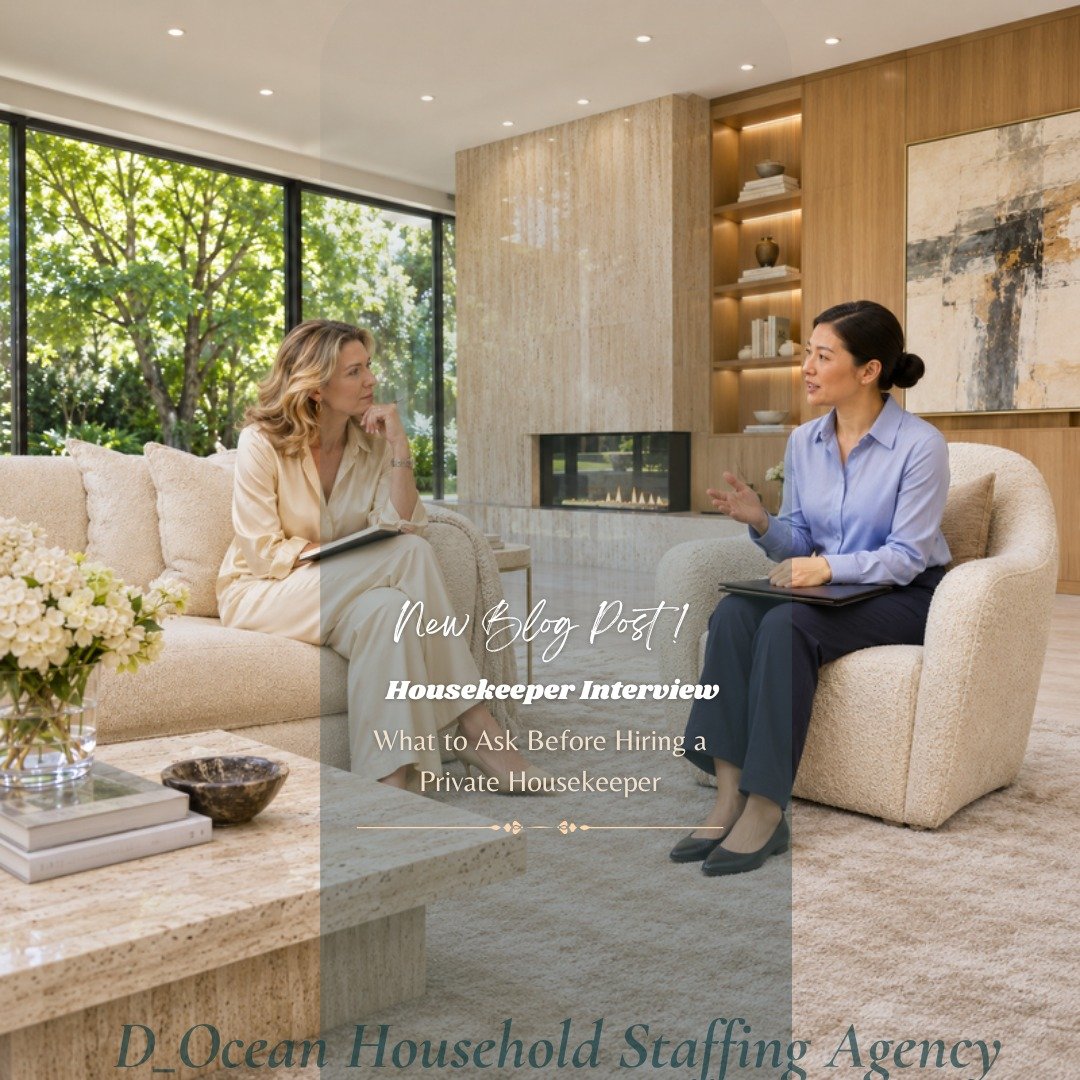
Why the Interview Matters When Hiring a Housekeeper
Housekeeping skills are only half of this role. The other half is conduct inside a private home: discretion, honesty, consistency, and the judgement to know what matters without being told every time. Some of it can be explored in conversation — in how a candidate describes her previous households, and in the questions she asks you in return — and the rest is confirmed by the steps around the interview: references from previous employers, and her work in your home during an agreed assessment. The interview is the centre of that process, not the whole of it.
The interview is also where the arrangement is set. Most housekeeper placements that fail do not fail over cleaning. They fail over things that were never said out loud: the house is larger than she expected, the day off keeps moving, the role quietly includes cooking for eight, or the family expects entertaining support that was never mentioned. A thorough interview protects both sides, because a good candidate is judging your household at the same time as you are judging her.
Questions About Experience and References
Start with her history, but ask in a way that produces real answers rather than a list of addresses. You are listening for stability, for the true scope of her previous roles, and for how she speaks about the families she has worked for.
- “Which households have you worked in, and for how long?” Explore her employment history in context. Long service in a household is encouraging, and short stays happen for ordinary reasons — a family relocated, children grew up, the role itself changed. Ask for specific examples, clarify anything that concerns you, and compare what she tells you with what her references say.
- “What did a normal day look like in your last position?” This reveals the real scope of her experience. A housekeeper who ran a large villa alone, with laundry, wardrobe care and guest preparation, is a different hire from one who cleaned two rooms in a staffed house.
- “Why did you leave your last position?” Candidates leave roles for many legitimate reasons, and some will have genuine concerns about a previous position. Listen to the reason, ask a follow-up if anything is unclear, and weigh the account alongside her references rather than judging the answer on its own.
- “Which parts of housekeeping do you do best, and which do you find hardest?” Self-awareness matters. Every housekeeper has strengths — one is meticulous with laundry, another is at her best keeping a large kitchen in order. You want to know which you are hiring.
- “Have you cared for delicate clothing, fine materials or antiques before?” Ask about whatever your home actually contains: silk and designer wardrobes, marble, silver, artwork. Honest limits are useful — they tell you where training or support would be needed.
- “What training or certificates do you hold?” Formal housekeeping training, first aid and similar certificates are worth knowing about, though long service in good households usually counts for more.
- “May we speak with your previous employers directly?” References are not a formality in private staffing; they are one of the main checks a family has, and experienced candidates expect to be asked. Through D’Ocean, reference contact details are shared with families for exactly this purpose, so the conversation happens directly.
Questions About Duties and Household Specifics
No two households mean the same thing by “housekeeping”. In one home it is daily cleaning and laundry for a couple. In another it is a team role covering a large villa, guest suites, a wardrobe room and regular entertaining. The interview is where your version of the role is described precisely, and where you test whether she has done this version before.
- “How would you organise the cleaning of a home like this across a week?” A strong candidate talks about rotation: daily tasks, weekly deep cleaning, and periodic jobs such as windows, chandeliers and inside cupboards. She has a system, even if she describes it simply.
- “How do you handle laundry and wardrobe care?” Ask about ironing standards, delicate fabrics, sorting, and how she returns clothes to wardrobes. In formal households some of this sits with a lady’s maid, but in most homes it belongs to the housekeeper, and it is where standards show first.

- “Are you comfortable helping in the kitchen?” Be precise about what this means in your home: keeping the kitchen in order, laying the table, preparing breakfast, or full cooking. Kitchen support and cooking are different jobs, and confusing them at interview causes problems later.
- “Which products and machines have you used, and are there any you avoid?” This tells you both her experience and her care. A good housekeeper knows that the wrong product ruins stone, wood and delicate surfaces, and says so.
- “How do you keep track of what has been done?” Lists, routines, a notebook, a weekly plan — the method matters less than the fact that she has one. Large homes cannot be run from memory.
- “When we entertain, what would you expect your role to be?” Guest preparation, service support, later evenings and the morning after: entertaining changes a housekeeper’s week. Agree in the interview what it involves in your household, rather than letting her discover it at the first dinner party.
- “Are you willing to take on [specific task] as part of the role?” Name anything that sits outside core housekeeping — errands, pet care, outdoor areas, helping with children occasionally — and discuss it openly now. Responsibilities outside housekeeping are legitimate when they are agreed; they cause resentment when they simply appear.
Describe your home honestly during this part of the interview: its size, who lives there, pets, how often you entertain, and which standards matter most to you. The right candidate will ask questions of her own, and her questions will tell you as much as her answers.
Questions About Trust, Background Checks and Confidentiality
A housekeeper works unsupervised, holds keys and alarm codes, receives deliveries, and is present for the ordinary private life of the family. Trust is therefore not a soft consideration in this hire; it is the centre of it. Ask about it directly, and expect direct answers.
- “Are you comfortable with a background check, and can you provide your documents?” Passport, visa status and any certificates will be needed, and it is reasonable for a candidate to ask how her documents will be held and used — explain that plainly. If anything cannot be produced, ask why and clarify the position before drawing conclusions.
- “In your last household, how were keys, alarms and deliveries handled?” Her answer shows whether she has worked in a home with proper security habits, and whether she treats them as normal.
- “What would you do if you broke or damaged something valuable?” Accidents happen in every home, and this question is about process rather than blame. A clear, straightforward answer — that she would tell you promptly and explain what happened — is what you are listening for, and it can then be weighed alongside her references.
- “How do you feel about working in a home where you will see and hear private family matters?” You are exploring discretion. A candidate who answers simply and seriously — that what happens in the house stays in the house — is describing the standard this work requires. If she speaks in detail about previous employers, note it, and weigh it with everything else you learn.
- “Who else lives or works in the home you are in now, and how do you divide the work?” Where she will work alongside other private household staff — a nanny, a cook, a driver — how she shares duties and space matters as much as how she works alone.
No one step settles the question of trust. The interview, her documents, her references and a practical assessment in your home are complementary steps: each confirms something the others cannot, and together they are the basis on which a family can decide with confidence.
Live-In or Live-Out: Hours, Days Off and Expectations
Whatever you do not discuss at the interview will be negotiated later, usually at a worse moment. A good housekeeper interview covers the whole arrangement openly: working hours, the weekly day off, the salary, accommodation where the role is live-in, the start date, and any responsibilities that sit outside ordinary housekeeping. Covering these points is not a lack of trust; it is how professional arrangements begin.
- Working hours and the day off. State the normal day — start, finish, breaks — and which day of the week is her day off. If the household’s rhythm means the day off occasionally moves, say so now and explain how it is handled.
- Evenings and entertaining. Housekeepers are not usually on overnight duty, but entertaining can mean a late finish. Ask: “If we entertain and the evening runs late, how do you feel about the occasional late evening, agreed in advance?” Occasional and agreed are the words that matter.
- Live-in accommodation. If the role is live-in, show her the room during the interview visit if you can. Ask: “What do you need in your accommodation to be comfortable?” Her own room and bathroom, and privacy on her day off, are the basics that make live-in arrangements last. Our live-in housekeeper guide covers the live-in arrangement in full, including duties and how families usually structure it.
- Live-out practicalities. If the role is live-out, discuss travel to the house, start times, and what happens when the family travels — whether she comes in to keep the house, or takes leave at the same time.
- Salary and start date. Raise both at the interview, plainly. A candidate who knows the package and the start date, and accepts both with her eyes open, begins the role settled. One who discovers them later begins it uncertain.
- House rules. Uniform if you require one, phone use during working hours, visitors, and how you prefer to communicate day to day — a note, a list, a short conversation each morning. Small rules stated early prevent most misunderstandings.
Ask her, too, what working pattern she has been used to and what she is looking for now: “What arrangement worked best for you in your last position?” A housekeeper whose life fits the pattern of the role — its hours, its location, its rhythm — stays. Fit is a practical matter, not a detail.
The Trial Period and Practical Assessment
No interview, however thorough, settles everything, which is why many families arrange a practical assessment or an agreed trial before a placement is confirmed. A practical trial is not the same thing as contractual probation, and the rules that govern working trials, authorisation, payment and rest days depend on the country and the employment arrangement. Before arranging any practical assessment or trial, confirm the applicable requirements and agree the duties, duration and payment arrangements in writing. That protects the family and the candidate alike.
Assess the work in this order:
- Standards. Are the rooms, laundry and kitchen kept to the level she described at interview, without reminders?
- Initiative. Does she notice what needs doing — the scuffed skirting board, the guest towels, the cupboard that needs sorting — or only complete the tasks she is given?
- Care. How does she treat the home’s belongings? Care shows in small things: how shoes are stored, how delicate items are handled, how products are put away.
- Communication. Does she report problems, breakages and low supplies promptly, or do you discover them yourself?
- Response to feedback. Every household does things its own way. A good housekeeper adjusts quickly and without taking offence when a preference is explained. How she responds to feedback is one of the clearest signs of whether the placement will settle.
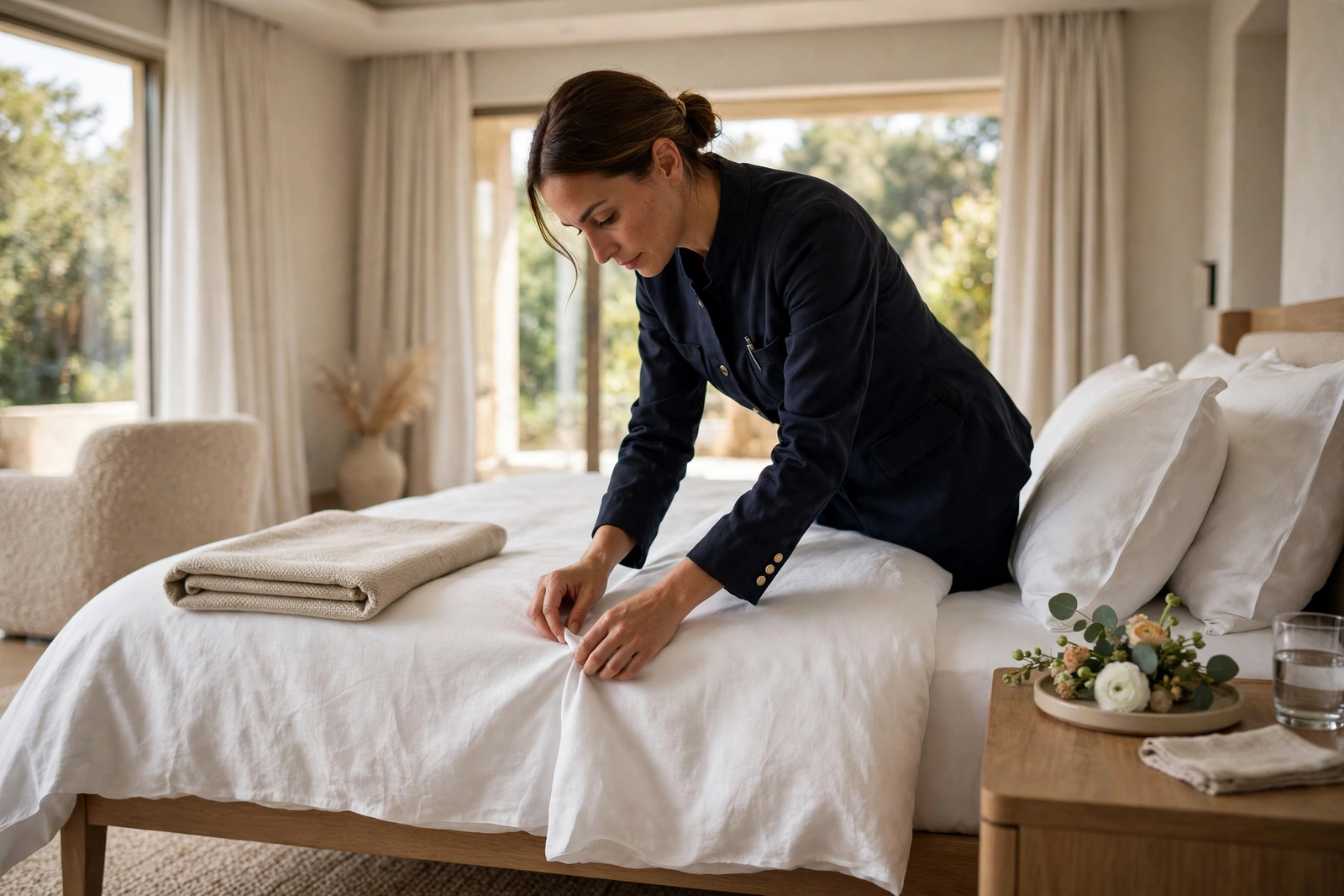
Give feedback early and specifically. “We like the bed made with the throw folded this way” in week one is a small conversation; the same point in month three feels like criticism. Most strong housekeepers improve visibly as they learn the house. If concerns do arise — agreed routines not being followed, or carelessness with private family matters — raise them promptly and specifically, and judge the response. An assessment arranged properly, with everything agreed in writing, gives both sides a fair basis for deciding whether to proceed.
How D’Ocean Assesses Housekeeping Candidates
Every search begins with understanding your household, the duties required and your preferred working arrangement.
We personally interview candidates, review their CVs and discuss their employment history, relevant responsibilities, communication skills and interest in the position.
Selected profiles are presented with our interview feedback. We also share candidate-provided professional reference contact details so families can speak directly with previous employers before making their hiring decision.
This approach helps families assess relevant experience and household suitability with a clearer understanding of each candidate.
D’Ocean Household Staffing is a licensed household staffing agency in the UAE. Through our housekeeping and maid service, we place vetted housekeepers, housekeeper-cooks and domestic staff with families in Dubai, across the Emirates, in Saudi Arabia and around the GCC and the wider Middle East.
Conclusion
The housekeeper interview is not an examination, and it is not a formality. It is the conversation in which a family explores the things that decide this hire — standards, judgement, honesty and discretion — alongside the practical terms of the arrangement, and it works together with references and a practical assessment, not instead of them. Ask for real examples. Speak to her previous employers yourself. Discuss hours, days off, accommodation and the start date openly. Then arrange any assessment properly, and give feedback early.
If you would rather begin from a shortlist that has already been interviewed, checked and matched to your household, D’Ocean offers a private, no-pressure conversation. Email info@doceanhouseholdstaffing.com or call +971 54 200 7886, Monday to Friday, 9 AM to 5 PM.
Frequently Asked Questions About Housekeeper Interviews
What are the most important questions to ask when interviewing a housekeeper?
The questions that matter most cover both sides of the role: her practical skills — including delicate fabrics, specialist finishes and valuable furnishings — and her judgement, discretion and communication. Ask what a normal day looked like in her last position, why she left it, what she would do if she damaged something valuable, and whether her previous employers can be spoken to directly. Alongside those, cover the duties of your specific household in detail, and agree hours, days off and the start date openly.
How do I check a housekeeper’s references?
Speak to previous employers yourself, by phone, rather than relying on written references alone. Ask how long she worked for them, what her duties were, how she handled the home’s private matters, and whether they would employ her again. Through D’Ocean, candidates’ professional reference contact details are shared with families precisely so these conversations can happen directly.
What should I discuss about hours and days off at the housekeeper interview?
Discuss the normal working day — start, finish and breaks — and which day of the week is her day off. If entertaining sometimes means a late evening, or the day off occasionally moves, say so at the interview and explain how it is handled. Arrangements agreed openly at the start rarely cause problems later; arrangements left unsaid often do.
Should salary be discussed at the interview?
Yes. The salary, the start date and, for live-in roles, the accommodation should all be raised plainly at the interview stage. There is no standard figure that can be quoted without knowing the household — the package depends on the size of the home, the duties, the working pattern and the experience required — but the figure for your role should be on the table before anyone commits, so the arrangement begins settled on both sides.
Is a trial period normal when hiring a housekeeper?
Many families arrange a practical assessment or an agreed trial before confirming a placement. A practical trial is not the same as contractual probation, and the requirements for working trials, authorisation, payment and rest days vary by country and arrangement. Before arranging any practical assessment or trial, confirm the applicable requirements and agree the duties, duration and payment arrangements in writing.
What are the red flags in a housekeeper interview?
Treat concerns as points to explore rather than instant verdicts. Vague answers about previous duties, claims about specialist skills that do not hold up when you ask for examples, or documents that cannot be produced without a clear explanation are all worth clarifying — and worth comparing with what her references say. Candidates may have legitimate reasons for leaving a role, or for asking how their documents will be used. Explore employment history in context, ask for specific examples, and clarify any concerns before deciding.
How does D’Ocean interview housekeepers before putting them forward?
Every search begins with your household: the duties required and your preferred working arrangement. Candidates are personally interviewed by D’Ocean, and we review their CVs and discuss their employment history, relevant responsibilities, communication skills and interest in the position. Selected profiles are presented with our interview feedback, and candidate-provided professional reference contact details are shared so you can speak directly with previous employers before making your hiring decision.
About the Author
This guide was written by D’Ocean Household Staffing, a Dubai-based consultancy that places housekeepers, nannies, butlers and other private household staff. It is general information, not legal advice. Rules and fees change. Confirm current requirements with the relevant authority before you hire.